
.png&w=128&q=75)
August 12, 2026
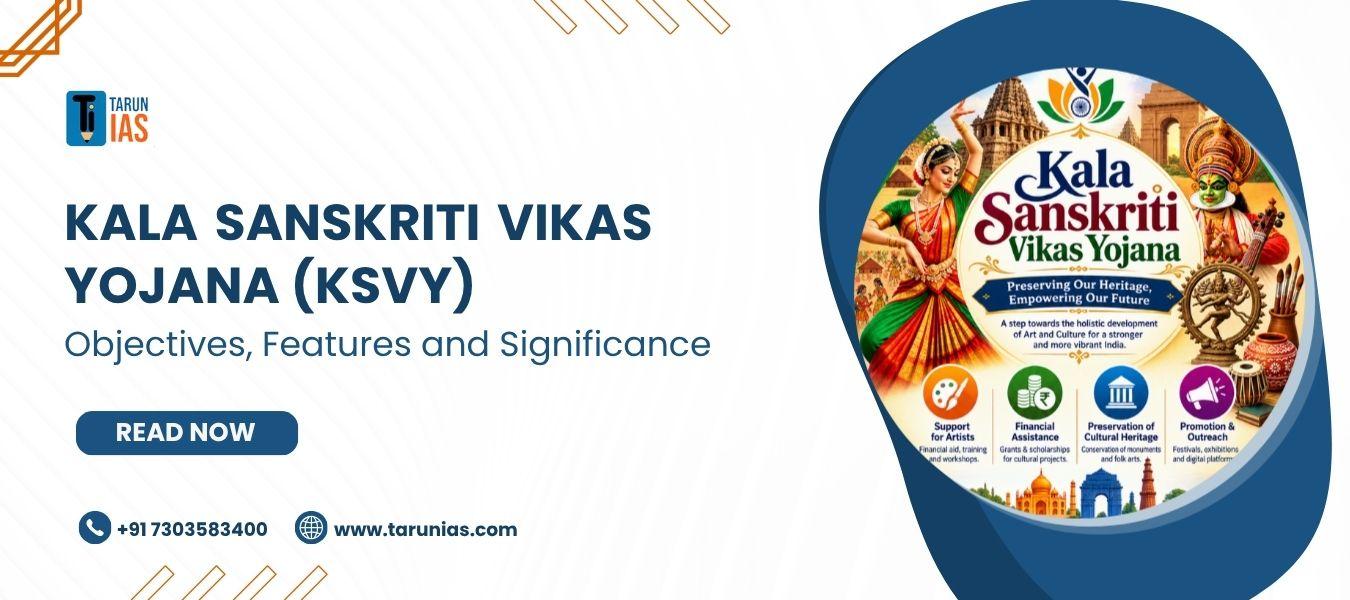
Kala Sanskriti Vikas Yojana (KSVY): Objectives, Features and Significance
Through art, music, literature, theatre, dance, crafts and traditions, the cultural legacy of India of many centuries has, today, an impact that continues to define the nation. Sustaining and upholding this rich heritage will necessitate ongoing efforts on the part of artists, cultural institutions and traditional arts. One such scheme to promote the preservation of culture and make it accessible to more people is the Kala Sanskriti Vikas Yojana (KSVY) by the Government of India.
For UPSC aspirants, Kala Sanskriti Vikas Yojana is an important topic under Indian Art and Culture as well as Government Schemes. It is important to understand its objectives, components and relevance in order to lay a strong foundation for Prelims and Mains examination. Other simplified learning materials and updated news updates can also be accessed through Tarun IAS.
What is Kala Sanskriti Vikas Yojana (KSVY)?
Kala Sanskriti Vikas Yojana (KSVY) is the Central Sector Scheme (CSC) introduced by the Ministry of Culture to encourage, preserve and promote the cultural heritage of India. The scheme offers financial support to artists, cultural initiatives, museums, libraries, research institutions and to a range of projects in the field of the preservation of traditional and contemporary art forms.
The scheme combines multiple cultural programmes under one roof to enhance the quality of their execution and ensure financial resources are more available to them. It is designed not only to safeguard the tangible and intangible cultural heritage of India, but to also promote public participation in the field of culture.
KSVY is not just about a tradition of the past but also an opportunity for artists and cultural institutions to sustain their practice in the ever changing social and economic context.
Objectives of Kala Sanskriti Vikas Yojana
The main aim of Kala Sanskriti Vikas Yojana is to ensure the maintenance of cultural diversity and to promote the traditional art forms which are in danger of being lost with the progress of modernisation in the lifestyle.
The other goal is to help people and groups who work in the area of culture. This scheme is able to provide support for many artists and institutions with restricted resources to enable them to undertake research, documentation, performances, exhibitions, publications and cultural events.
The scheme also seeks to inspire young artists by providing opportunities for training and scholarships as well as joining cultural programmes. It contributes to the transfer of traditional knowledge from one generation to the next and to the continuity of traditional arts in today's world.
KSVY also endeavors to preserve rare manuscripts, history records, region languages and cultural exchanges among various regions of the country. The scheme aids in promoting national integration and also in eclectic Indian cultural diversity.
Key Features of Kala Sanskriti Vikas Yojana
There are some sub-schemes under Kala Sanskriti Vikas Yojana which are helpful in various fields of Indian culture. These include the visual arts, the performing arts, literature, museums and archives, cultural research and heritage conservation.
It is a scheme for organising festivals, workshops, seminars, exhibitions and educational programmes for registered cultural organizations through grants. This kind of activity can help sensitize the minds of students and public in respect to Indian art heritage.
Financial assistance is also given to preserve the manuscripts, maintain museums, digitise historical records and encourage the preservation of traditional knowledge systems. Such efforts contribute to conservation of important cultural resources for future generations.
The opportunities are provided to young artists and scholars through scholarships and fellowships which promote higher education and research in the field of Indian culture. These programs offer opportunities for those with exceptional talent to pursue their artistic and academic studies without significant financial constraints.
The scheme is also extended to include institutions that preserve folklore, tribal traditions, local literature and traditional art forms. KSVY captures and shares these traditions, ensuring that the valuable cultural heritage is not lost.
Significance of Kala Sanskriti Vikas Yojana
Kala Sanskriti Vikas Yojana is an important initiative for the preservation of the identity of Indian culture. Each area of the country has its own customs, languages, crafts, music and festivals. Some of these cultural practices are in danger due to the impact of lifestyle changes and a decrease in economic opportunities for artists. The scheme offers the necessary support to sustain the traditions.
The programme also develops jobs for artists, actors, craftsmen, writers, researchers and cultural professionals. Financial support helps them go on with their art and spread it out to other people.
One of the key points of the scheme is cultural education. Museums, exhibitions, cultural festivals and educational programmes under KSVY work for the benefit of students, researchers and young learners. This promotes the knowledge of the past and heritage in India.
The scheme also helps in cultural tourism as well. The monuments and museums are preserved and the festivals and traditional performances are well organised which draw visitors from all over India and abroad. Not only does it help promote Indian culture, but it also aids local economies that are linked with tourism.
The scheme has led to the valuable documents and manuscripts being made available for research and protected from physical damage through the process of digitisation. This enhances academic study and helps transfer knowledge to future generations.
Relevance for UPSC Examination
Kala Sanskriti Vikas Yojana is applicable for various stages of UPSC Examination. The preliminary examination might contain questions on the government schemes for cultural preservation. The scheme may be related to topics like Indian culture, heritage conservation, governance, social development and public policy in the Mains examination.
The answer should include an explanation of the goals of the scheme, highlight its key features, discuss its impact on the conservation of cultural heritage, and connect it to broader conservation and development initiatives in India.
Candidates are also expected to link the scheme to the values enshrined in the Constitution which favour the preservation of the cultural heritage of India and enlist the participation of citizens in this process.
Challenges Associated with the Scheme
While Kala Sanskriti Vikas Yojana has offered some positive effects, there are still some challenges to be faced. Artists and small cultural bodies in rural areas are not completely aware of the scheme and how to apply. Limited outreach and administrative delays may also affect the effectiveness of financial assistance.
Monitoring, public awareness, greater utilization of digital platforms, and better coordination between the Central government and State governments can be useful to enhance implementation. Incorporating educational institutions and communities can also boost participation in cultural activities funded under the scheme.
Conclusion
Kala Sanskriti Vikas Yojana is an important initiative that supports the preservation and promotion of India's rich cultural heritage. By providing financial assistance to artists, researchers, cultural organizations, museums, and heritage institutions, the scheme helps protect traditions that define the country's identity. It also encourages cultural education, research, tourism, and the continuation of traditional knowledge systems.
For UPSC aspirants, understanding the objectives, features, and significance of Kala Sanskriti Vikas Yojana is valuable for both Prelims and Mains preparation. A clear understanding of such schemes also helps build a broader perspective on governance, heritage conservation, and India's cultural development.