.png&w=128&q=75)
September 17, 2026
GOBARdhan Scheme - Objectives, Benefits and Challenges
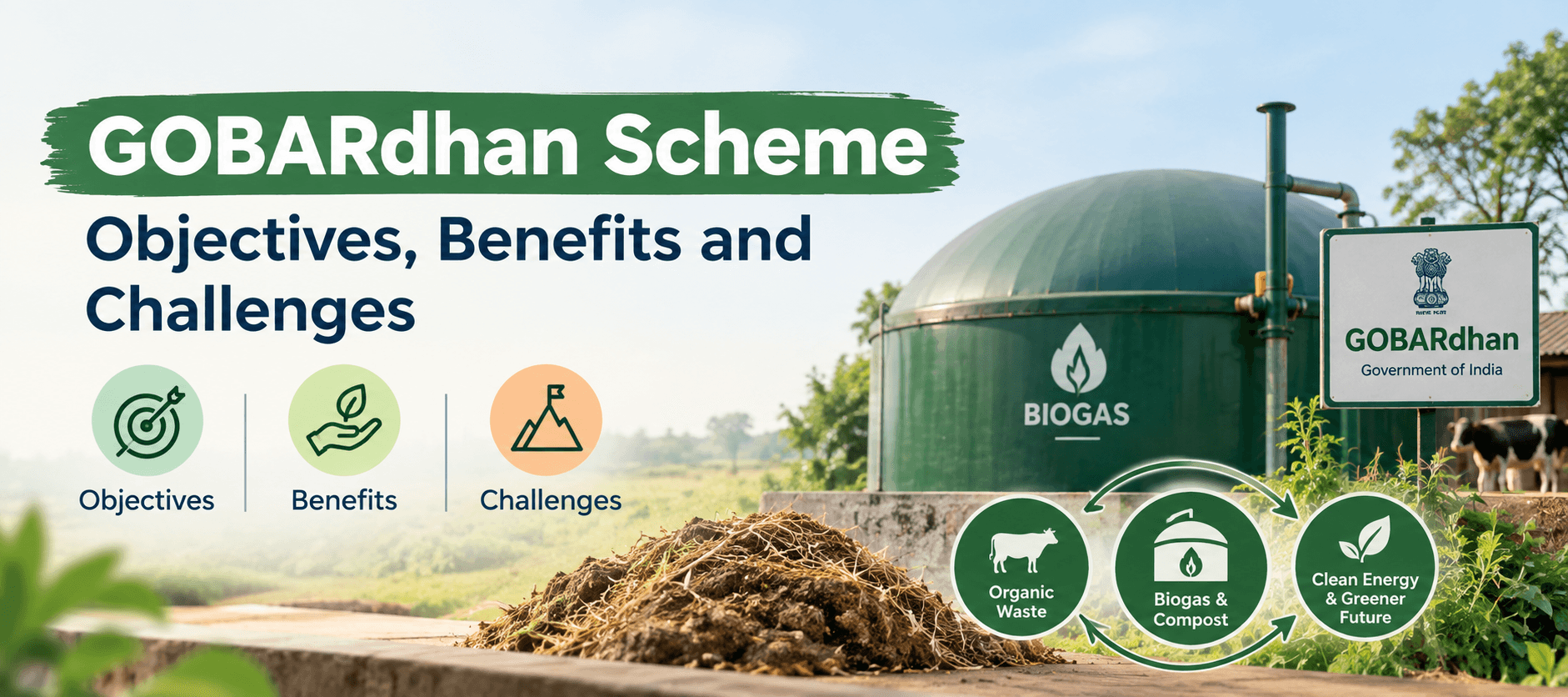
India's villages produce huge amounts of cattle dung, agricultural wastes, kitchen wastes and other biodegradable waste on a daily basis. A large part of this waste is either untreated or dumped in a manner which causes environmental and sanitation issues. With the view to leveraging this challenge into an opportunity, the GOBARdhan Scheme aims to transform organic waste into beneficial products like bio-gas, Compressed Bio-Gas (CBG), bio-slurry and bio-manure.
GOBARdhan means Galvanizing Organic Bio-Agro Resources Dhan. It was announced in the Union Budget 2018 and was inaugurated as a part of Swachh Bharat Mission (Grameen). The concept is a simple one - waste is not garbage to throw away, it is a resource to be used.
What is the GOBARdhan Scheme ?
GOBARdhan gave tremendous empahsis on rural sanitation and converting biodegradable waste into bio-gas and bio-slurry initially. The scheme will allow cattle dung, crop residue, kitchen waste and other organic material to be used in biogas plants.
It has been slowly moving beyond the village sanitation. In 2026, GOBARdhan was approved as a National Circular Bioenergy Scheme with an outlay of ₹23,731 crore from FY 2026-27 to FY 2035-36 by the Union Cabinet. The new framework puts a greater focus on scaling up compressed Bio-Gas production and promotes private investment and a more robust waste-to-energy ecosystem.
This is not just about sanitation but also abut energy security, rural development and the circular economy in India and hence GOBARdhan is important.
Objectives of the GOBARdhan Scheme
The scheme has a number of interrelated aims:
1. Scientific management of organic waste
One of the main aims is to collect and treat the waste generated by cattle, agricultural waste, kitchen waste and other organic waste rather than throwing it away or incinerating it. This can contribute to cleaner villages and a decrease in local pollution.
Use of clean energy.
2. Production of clean energy
Organic waste can be used to make biogas and subsequently CBG by using cleaning. CBG can be used as an alternative fuel to conventional fossil fuels and can help to decrease importation reliance.
3. Promotion of a circular economy
The concept of GOBARdhan is based on “waste to wealth.” Waste from one activity is utilized in another activity. The bio-slurry will be used as organic manure, and the biogas will be used as fuel.
4. Creating rural livelihood opportunities
Biogas and CBG plants can generate jobs in waste collection, transport, plant operation and manure production, and its associated services. The government also hopes that the new scheme will spur rural entrepreneurship and private investment.
5. Supporting sustainable agriculture
The bio-slurry and manure from these plants can help maintain the health of soils and encourage organic inputs to agriculture. The government has also announced Market Development Assistance for some of the organic fertilizers manufactured from GOBARdhan and CBG plants.
Benefits of the GOBARdhan Scheme
GOBARdhan's impacts span environmental, economic, and social aspects.
Cleaner villages: Better cattle waste management and other organic waste disposal can help to decrease the open dumping and enhance rural sanitation.
Renewable energy: Biogas and CBG are sources of renewable energy which can replace traditional fossil fuels while utilising biomass that is available locally.
Additional income for farmers: Waste as cattle dung and crop waste can be utilized as an economic resource in lieu of being considered as waste materials added to the farmer's income.
Employment generation: The entire value chain - from collection, transportation, processing to marketing - can generate local jobs.
Reduced greenhouse gas emissions: Lower greenhouse gas emission: Scientific treatment of biodegradable waste can help to lower emissions from uncontrolled decomposition and waste burning.
Energy security: The larger framework for 2026 will focus on boosting domestic CBG supplies by almost tenfold, which will help reduce reliance on imported fossil fuels.
The scheme servers as a valuable model for aspirants of UPSC, where all the concepts of environmental sustainability, rural development, renewable energy and circular economy are intertwined and sybergized.
Challenges of the GOBARdhan Scheme
Although it has potential, there are some implementation challenges.
Feedstock collection and transportation
Biogas/ CBG plants need a continual availability of organic waste. Transporting biological waste from scattered cattle dung and agricultural residue from villages in an economical way can be challenging.
High initial investment
Establishing the processing plants, storage, transportation systems and all supporting infrastructure is a significant investment. Smaller rural bodies can be subject to financial and technical constraints.
Technology and maintenance
It is essential to have proper design of biogas plants, trained manpower and regular maintenance. Efficiency and financial sustainability of projects can be adversely impacted by poor operation.
Market and price issues
CBG producers must have stable demand and remunerative prices for the projects to be sustainable. The 2026 GOBARdhan framework tries to cater to this by guaranteeing offtake, fixed price, and providing capital support and infrastructure.
Coordination among stakeholders
The scheme is panchayat, farmer and government of multiple Union ministries and private companies. In effect, coordination and responsibilities are key in successful implementation.
Way Forward
The success of GOBARdhan will rely on having a complete and sustainable value chain, beyond just plant construction. Proper waste management system, robust Panchayati Raj, technical training, market linkage and awareness among farmers can make a difference.
Technology can also be important in the monitoring of plants, tracking feedstock and improving operational efficiency. Local communities should also be engaged since long-term waste management is impossible without engaging at the grassroots level.