
.png&w=128&q=75)
September 15, 2026
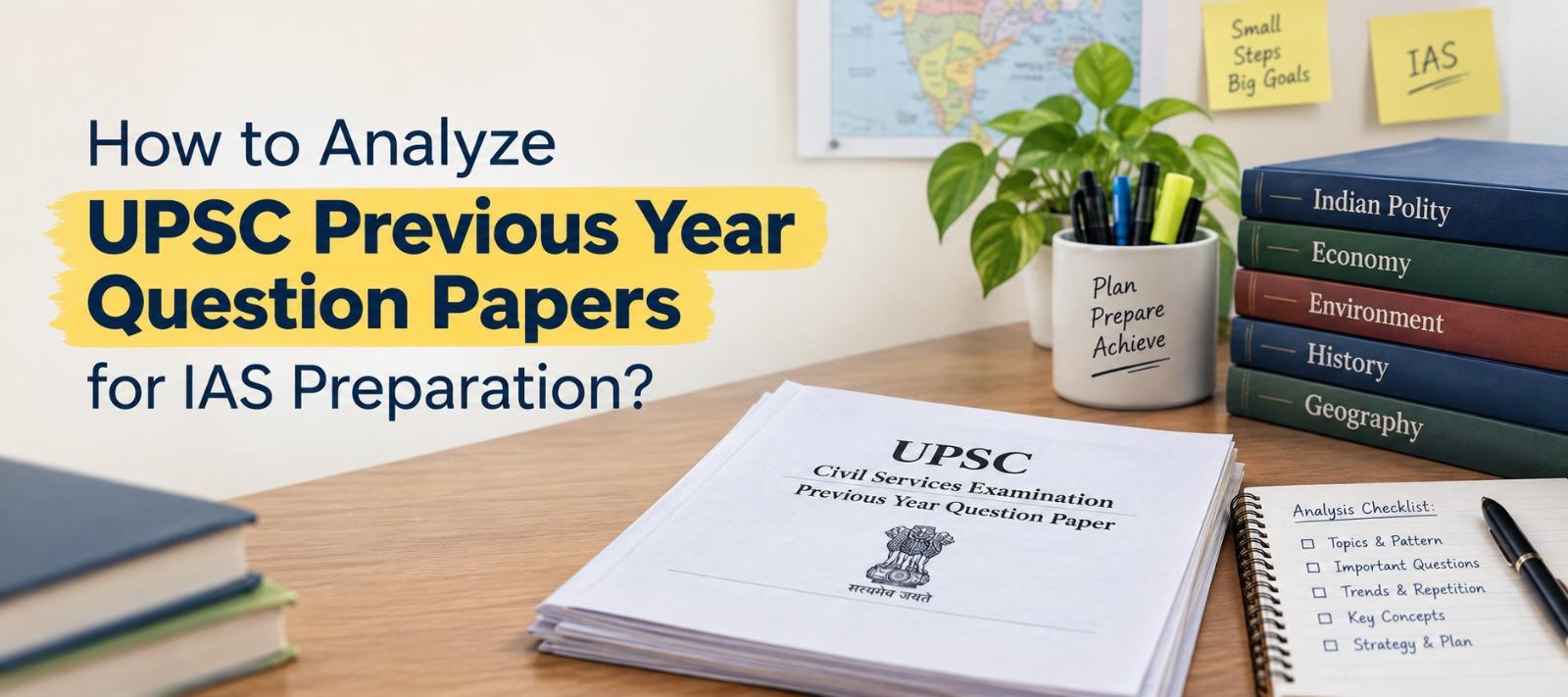
How to Analyze UPSC Previous Year Question Papers for IAS Preparation?
The UPSC Civil Services Examination preparation is always daunting. You have a vast syllabus to cover, the number of books and resources that you have to choose from and the current affairs to keep up with. Amidst all this, one thing that many aspirants miss out is the UPSC Previous Year Question Paper (PYQ).
While solving PYQ's is important, it is not sufficient to answer the questions. The advantage lies in analysing the questions and understanding what UPS expects from the aspirant.
The Union Public Service Commission offers previous year question papers for Civil Services Preliminary and Main exams on its website; these are a useful resource for preparing.
So how to effectively analyze them?
1. Start With the Syllabus
Always have the official UPSC syllabus next to you while opening a PYQ. This adds meaning to your analysis.
Take a question and ask yourself:
- To which part of the syllabus does it relate?
- Does it have a specific topic connection?
- Does it relate to more than one subject?
- Do you need factual information or conceptual understanding or current information?
For instance, rather than just stating that a question relates to Environment, specify the precise part of the syllabus that the question covers. You will begin to notice that subject after subject is tackled in various ways.
2. Analyse at Least 5-10 Years of PYQs
Seeing just one year's paper, you may have a wrong impression. The questions are framed differently in UPSC every year, hence studying more papers helps to find out the general trends.
Research 5-10 years of past papers, focusing on General Studies and your choice of optional paper.
Please don't rush through these. Your goal is not to complete so many papers, but to know and understand:
- Frequently tested areas
- Repeated concepts
- Changing question patterns
- Important themes
- Difficulty level
- Interlinkages between subjects
It is possible that the same question will not be asked again, but the same idea or theme may be expressed in a different way.
3. Categorize Every Question
It is one of the simplest ways to make the PYQ analysis useful to create categories:
On each question draw a line under one of the following:
Static: Can generally be explained in conventional textbooks and with basic concepts.
Current Affairs Based: Information should be recent or recent developments.
Conceptual: Evaluates understanding of concepts, and not memory of facts.
Analytical: Needs to link together several aspects of a topic.
Interdisciplinary: When two or more subjects are combined.
In this exercise, you will learn that preparation for the UPSC isn't just about memorising information. The test is getting more focused on how far you can go to understand, connect and apply what you've learned.
4. Look Beyond the Question
One of the common pitfalls is to read a PYQ, see the answer and leave.
Rather, take a little time and find out the reason why UPSC has asked this question.
If the question relates to a specific part of the constitution, such as a specific provision, do not limit your preparation to that one provision. Update the concepts, provisions, key judgements and current issues related to the constitution.
Try to consider each PYQ as a gateway to a bigger topic.
This way, you can make your understanding deeper, and you will not read the topics which are not relevant to the examination.
5. Study the Question Language Carefully
UPSC's wording matters.
Phrasing a question using words like consider, examine, discuss, critically analyse, which of the following and how far can alter the nature of the question you are asked to answer.
Pay special attention to the command in the question for Mains. The difference between a question that asks you to "discuss" and one that asks you to "critically examine" is that the latter asks you to think critically about a topic.
When going through PYQs, underline these directive words and consider the type of answer required.
It is a practice that will be very helpful when you begin to write Mains answers one day.
6. Identify Your Weak Areas
Also, PYQ analysis should reveal the areas of your preparation that are weak.
If you can comfortably answer the questions from Indian Polity and keep on getting stuck with the Economy or Environment ones, then perhaps you should practice them separately.
This information is helpful.
Create a simple tracker with three columns:
| Topic | Questions Attempted | Preparation Status |
| Polity | 40 | Strong |
| Economy | 35 | Need Revision |
| Environment | 30 | Weak |
| History | 40 | Moderate |
You don't have to use complicated software or spreadsheets. You can even use a notebook.
The one thing it is designed to do is to help your target your preparation.
7. Use PYQs for Revision
The PYQs should not be considered as problems that can only be solved before Prelims or Mains.
After finishing a topic, review the questions for the topic. This can help you to see if your knowledge is on par with UPSC's questions.
PYQs can also be a wonderful revision tool before the examination. Rather than editing each page of each book, you can concentrate more finely on those parts which have consistently been present in the test.
8. Don't Try to Predict the Exact Questions
The biggest error that can be made in the PYQ analysis is assuming that a topic will definitely be repeated.
UPSC PYQs are designed to give you an idea about the nature of the exam, and not necessarily to tell you what to expect in the next paper.
The same question does not necessarily reappear if it is repeated on the topic. All that is important is to have a good understanding of the concept so as to be able to solve a new problem based on it.
Final Thought
When you fail to think of the Syllabus, Books, Current Affairs, and PYQs as distinct entities, you will find your UPSC preparation much more focused. All of them are linked by PYQs.
A good PYQ analysis gives you direction on what the UPSC is asking, how much weightage it is giving to a particular area, what level of detail is required to study a topic and the way to approach it.
For IAS aspirants, this can help save a lot of time and provide more direction to daily preparation. It is best to develop a habit of analysing the examination on one's own, and resources/ guidance from platforms like Tarun IAS can complement that.
Note that it is not about solving the previous year questions. Explore them, ask questions of them and learn from them. That's what the real purpose of PYQs is.