
.png&w=128&q=75)

Rohin Kumar
Mentor
Rohin Kumar
If you look at most serious aspirants, one thing becomes clear very quickly: the issue is rarely effort. Students are studying hard, following multiple sources, and trying to stay consistent, yet the effort often does not translate into results. This is where mentorship becomes important — providing clarity, direction, and structure to their preparation.
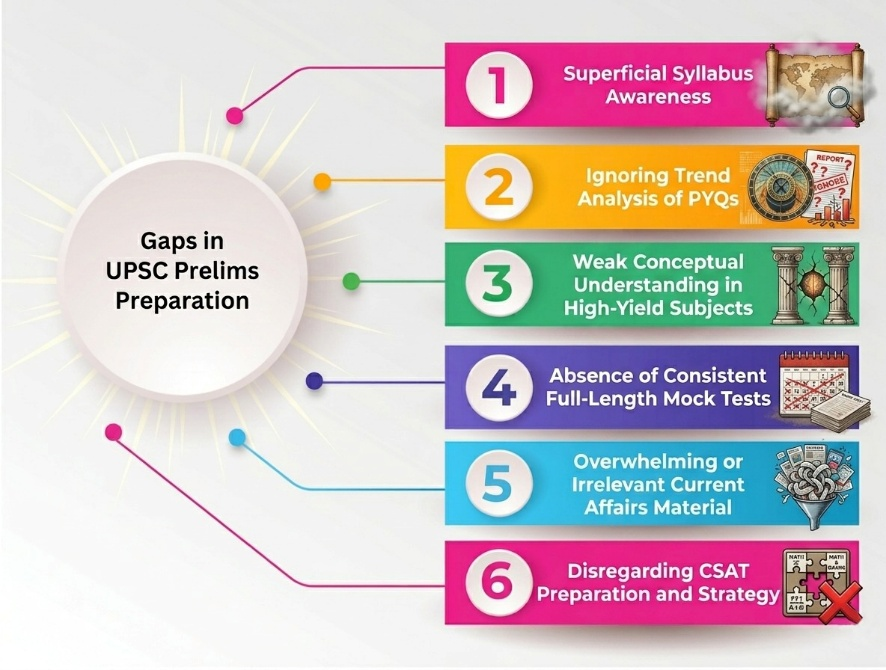
For many students, even after months — sometimes years — the output doesn’t change much.
Marks don’t improve in proportion to effort. Answers remain average. Preparation feels heavy, but not effective.
At some point, it is worth asking a simple question: what exactly is missing?
In most cases, the gap is not knowledge. It is the absence of continuous, external correction.
Preparation, when left entirely to oneself, tends to become repetitive. You keep doing more of what you are already doing — even if it is not working. Over time, this builds a false sense of productivity without real improvement.
This UPSC Mentorship Program Online has been built around that exact problem.
The idea is not to add more material or more instructions. It is to make sure that your preparation is seen, evaluated, and corrected at the right time, before inefficiencies become habits.
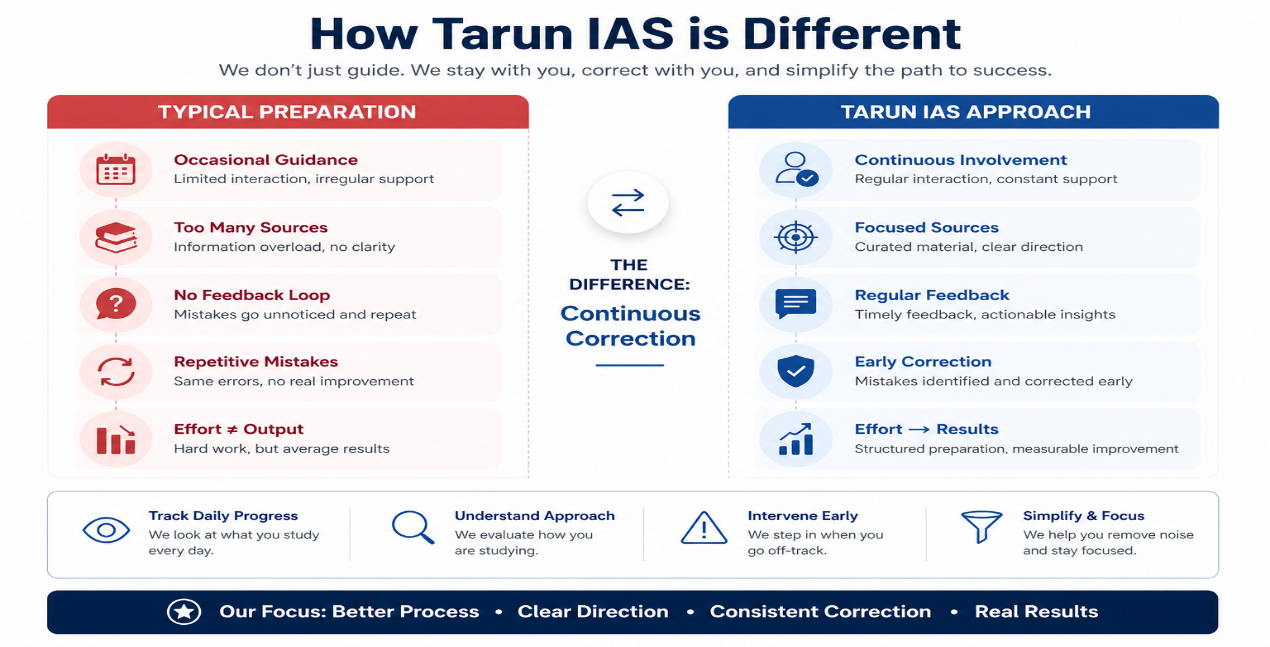
A typical Online Mentorship Program for UPSC often ends up being a lighter version of coaching — some schedules, a few interactions, maybe periodic guidance.
But preparation does not really change with that.
What most aspirants actually need is not occasional advice, but ongoing involvement in their preparation.
In this Online Mentorship Program for UPSC, the effort is to stay close to the process — not just the outcome.
That means:
There is also a deliberate emphasis on reduction. Many aspirants suffer from doing too much — too many sources, too many notes, too many strategies. Left unchecked, this creates confusion instead of clarity.
So a part of the process here is also to simplify. To cut down what is unnecessary. To bring the preparation to a point where it is manageable, repeatable, and relevant.
Over time, this is what builds confidence — not the volume of study, but the sense that what you are doing is actually aligned with the exam.

The Online UPSC Mentorship Classes are not structured like conventional teaching sessions. In fact, if someone is expecting topic completion in the usual sense, they may find these slightly different.
The purpose here is not to keep adding information. It is to engage with how that information is being used.
A significant portion of these Online UPSC Mentorship Classes revolves around:
Often, small issues create larger problems — writing without addressing the demand of the question, adding content without structure, or missing clarity in basic concepts. These are not always visible to the aspirant while studying alone.
When these are pointed out, sometimes repeatedly, the improvement is gradual but real.
There can be a certain discomfort in this process. Being told that something is not working is never easy. But over time, this becomes the turning point in preparation.
Every UPSC Mentorship Batch Online is kept structured, not to restrict flexibility, but to prevent drift.
One of the common patterns in UPSC preparation is inconsistency. Not always in terms of hours, but in terms of direction. One week is spent on one subject, the next week shifts entirely, and slowly the preparation loses continuity.
Within a UPSC Mentorship Batch Online, there is an attempt to stabilise this.
The structure usually includes:
This does not mean rigidity. There is room for adjustment based on individual pace. But the larger idea is to ensure that preparation does not become random.
Over time, this kind of environment builds a certain rhythm. And once that rhythm is established, consistency becomes easier.
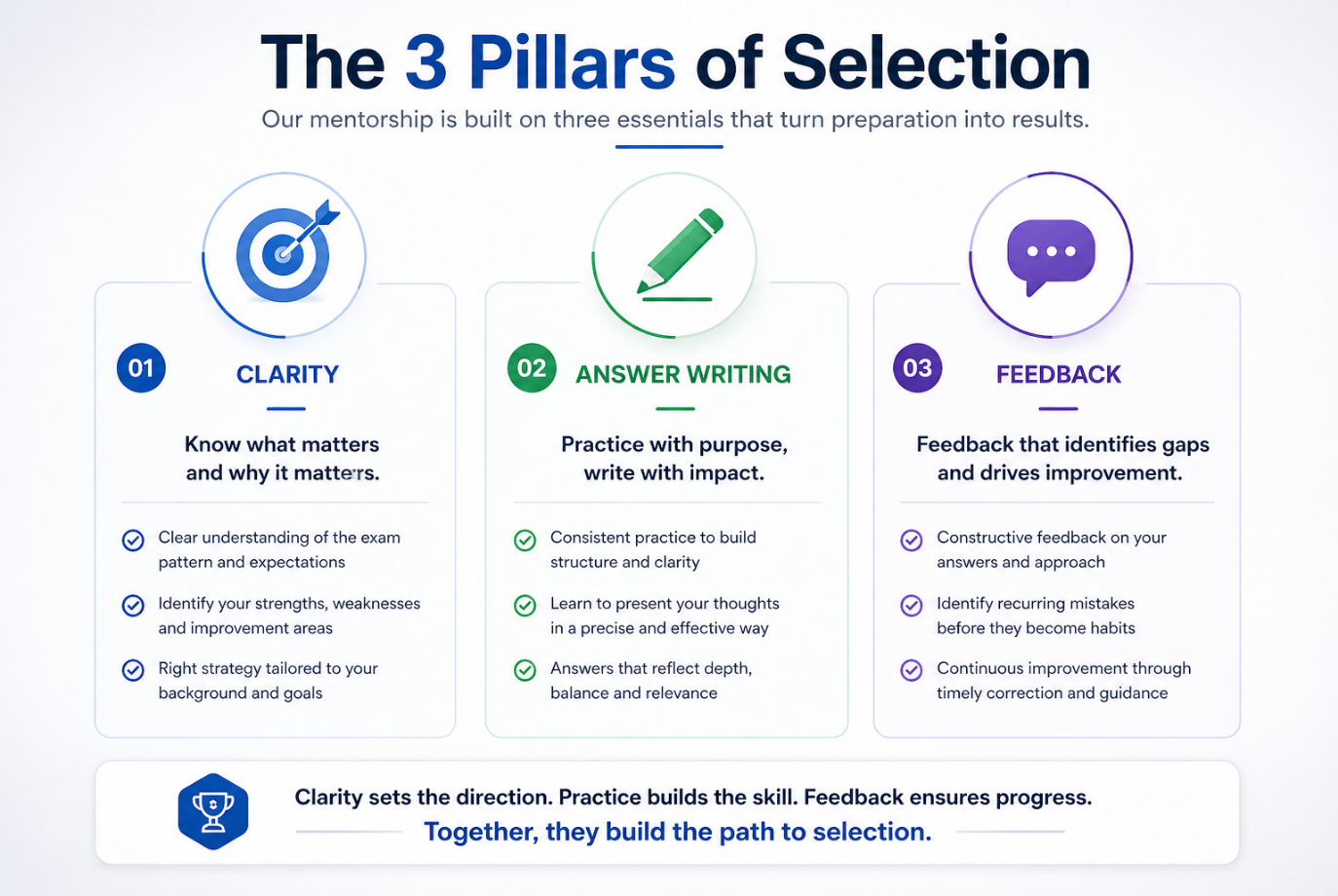
Even within a structured system, not everyone struggles with the same things. That is where One-to-One Mentorship for UPSC becomes important.
Some aspirants are comfortable with concepts but struggle with expression. Others write well but lack depth. Some are consistent but unsure about direction.
Through One-to-One Mentorship for UPSC, these differences are addressed more directly.
The conversations here are usually more specific:
There is no fixed template for this. The interaction evolves depending on the aspirant.
In many cases, small course corrections at this stage prevent much larger problems later.
Preparation evolves over time. What works initially is very different from what is required closer to the exam.
Instead of treating preparation as one continuous effort, this program structures it into clearly defined phases.
Phase 1 is where we focus on building and consolidating the foundation – by the end of this phase a student will not only be able to solve MCQ’s related to the big 4 i.e. Polity, Economy, geography and history but will also be able to effectively write answers from the static part.
Phase 2 is where most of the actual improvement happens. Every topic mentioned in the Mains syllabus is taken up and dimensions & comprehensive content related to it is shared with the student. After that we ensure that student writes all the PYQ’s of the topic and the mentor helps him predict the FYQ’s as well i.e future year questions. This phase is usually the most demanding one, with regular answer writing and consistent feedback.
Phase 3 is more about control. By this stage, the focus shifts to refining what has already been built — improving speed, tightening answers, and managing revision.
This separation is flexible rather than rigid, ensuring preparation always aligns with the aspirant’s current stage and evolving needs.
The process usually begins with understanding the aspirant’s current position. Not just in terms of syllabus coverage, but in terms of clarity, consistency, and answer-writing ability.
Based on this, a working plan is created.
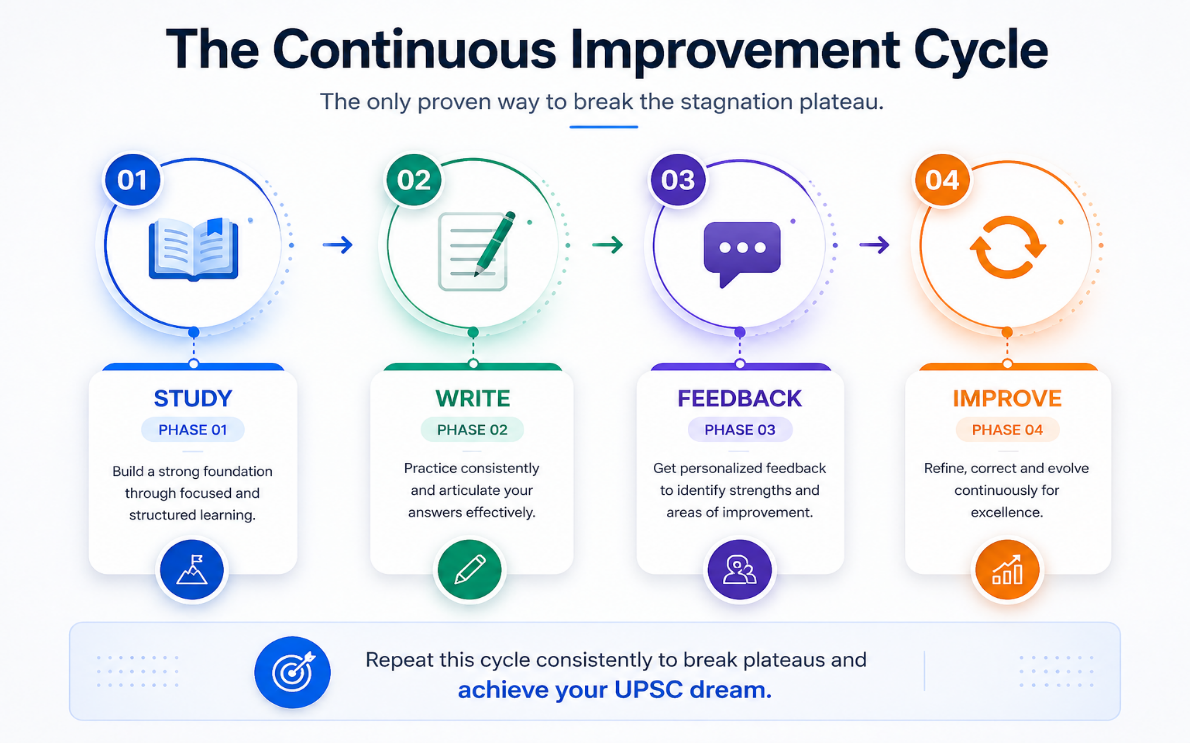
From there, the system moves into a cycle:
This cycle repeats. That repetition is important — not of content, but of improvement loops.
At certain points, the preparation is also reviewed more broadly to see whether the approach itself needs to change.

Over time, the visible change is not just in how much you know, but in how you approach the exam.
There is better clarity in:
There is also a gradual shift from uncertainty to control. Instead of constantly questioning whether you are doing the right thing, you begin to see a clearer connection between effort and output.
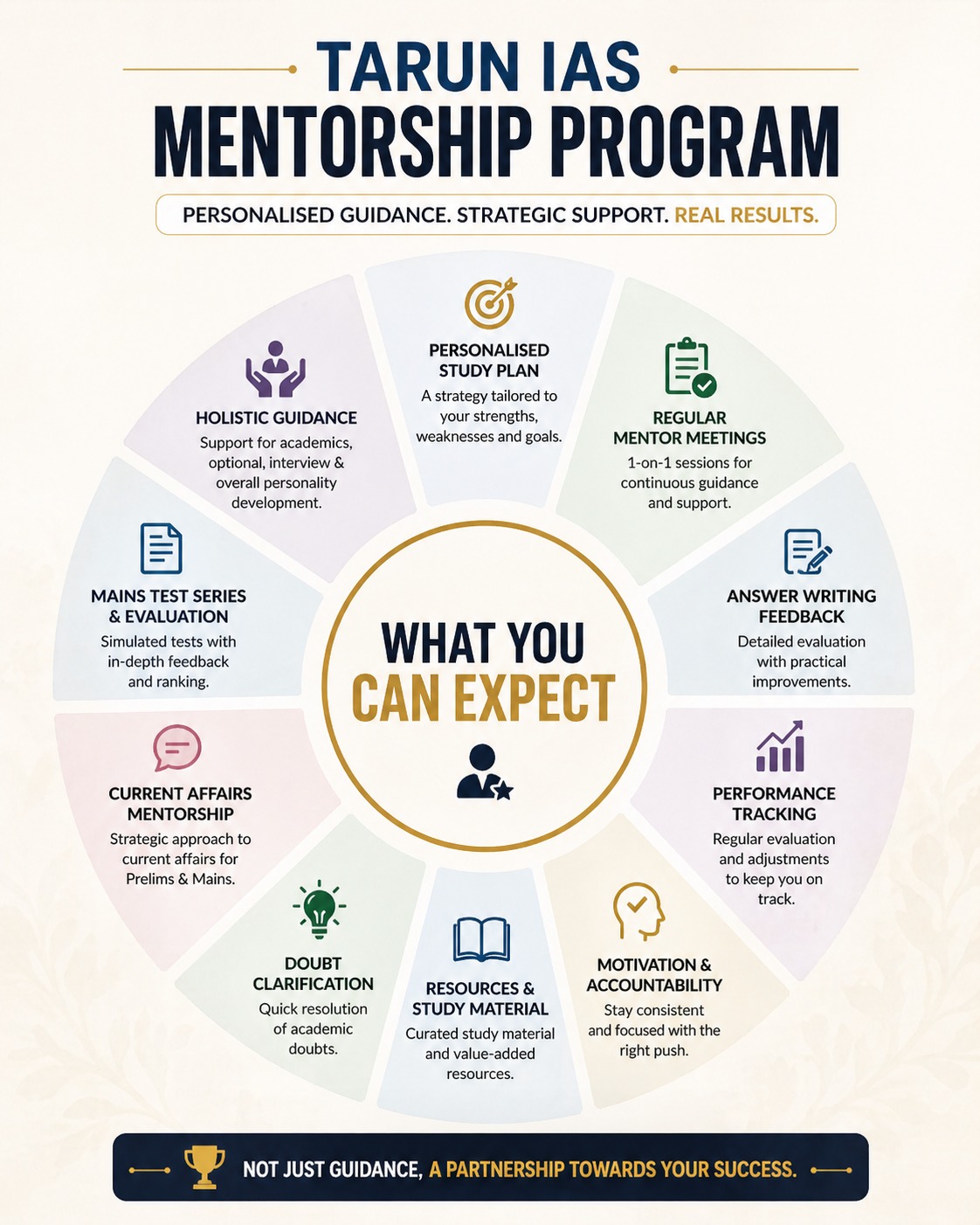
There is no single program that works for everyone. But for aspirants who feel that their preparation lacks direction, or that despite effort there is limited improvement, a system like this can make a difference.
This is why, for a certain category of serious aspirants, this can function as the Best Mentorship Programme for UPSC — not because it promises results, but because it focuses on improving the process that leads to results.
This UPSC Mentorship Program Online tends to work best for those who are already willing to put in effort, but want that effort to be better guided.
It is particularly useful for:
Learn with experienced mentors focused on structured guidance, answer writing, and exam strategy.
Mentor
Rohin Kumar

Mentor
Yogita Singh Dhami

Mentor
Vikas Kundu

Mentor
Shivin

Mentor
Shantanu Sharma

Mentor
Saumya Chaudhary

Mentor
Kajol Dubey

Personalized mentoring sessions tailored to individual needs for guidance and growth.
.png&w=3840&q=75)
Stay informed with the latest news, trends, and updates. Subscribe now to never miss an important update!
.png&w=3840&q=75)
Access exclusive content and exam materials to boost your preparation. Stay ahead with expert resources!